Search Books and Solutions Manual

Hire My Expertise

if you need help regarding semester projects, assessment/assignment related to web development(php, html, css, javascript, ajax,) or java, c, c++, c#, asp.net, ror, scala or pythn then please hire my expertise. i am professionally software developer. working as a Android & Web Developer. i'll provide my best to fulfil task in time.If you need new website or app or require any kind of digital resource, Please feel free to get in touch without wasting any single minute. I would love to work with you. Please send your requirement. i'll come back to you in time.

For more information, feel free to contact: muhammadmustafa1@hotmail.com

Free Books and Solutions Manual Headline

Showing posts with label Oriented. Show all posts

Friday, 17 June 2011

Object Oriented Reengineering Patterns: By Solutionsfree.blogspot.com(Free Books and Solutions Manual,Free eBooks,BSCS,BCS,Free Downloadable Books)


Object Oriented Reengineering Patterns

Object Oriented Reengineering Patterns
product description :
The documentation is missing or obsolete, and the original developers have departed. Your team has limited understanding of the system, and unit tests are missing for many, if not all, of the components. When you fix a bug in one place, another bug pops up somewhere else in the system. Long rebuild times make any change difficult. All of these are signs of software that is close to the breaking point. Many systems can be upgraded or simply thrown away if they no longer serve their purpose. Legacy software, however, is crucial for operations and needs to be continually available and upgraded. How can you reduce the complexity of a legacy system sufficiently so that it can continue to be used and adapted at acceptable cost?
Based on the authors’ industrial experiences, this book is a guide on how to reverse engineer legacy systems to understand their problems, and then reengineer those systems to meet new demands. Patterns are used to clarify and explain the process of understanding large code bases, hence transforming them to meet new requirements. The key insight is that the right design and organization of your system is not something that can be evident from the initial requirements alone, but rather as a consequence of understanding how these requirements evolve.

* Describes how to reverse engineer a monolithic system to understand how it really works and how to identify potential problems.
* Includes reengineering patterns that tackle well-known reengineering techniques often encountered in object-oriented programming, such as introducing polymorphism, factoring out common behavior, detecting duplicated code, and understanding design.
* Shows how to build a culture of continuous reengineering for achieving flexible and maintainable object-oriented systems.

to download follow the link below:

Thursday, 16 June 2011

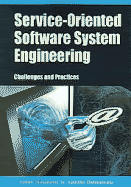
Service-Oriented Software System Engineering Challenges and Practices: By Solutionsfree.blogspot.com(Free Books and Solutions Manual,Free eBooks,BSCS,BCS,Free Downloadable Books)


Service-Oriented Software System Engineering Challenges and Practices

Service-Oriented Software System Engineering Challenges and Practices

Product Description
Current IT developments like component-based development and Web services have emerged as effective ways of building complex enterprise-scale information systems and providing enterprise application integration. To aid this process, platforms such as .NET and WebSphere have become standards in web-based systems development. However, there are still a lot of issues that need to be addressed before service-oriented software engineering (SOSE) becomes a prominent and widely accepted paradigm for enterprise information systems development and integration. Service-Oriented Software System Engineering: Challenges and Practices provides a comprehensive view of SOSE through a number of different perspectives. Some of those perspectives include: service-based concepts, modeling and documentation, service discovery and composition, service-oriented architecture, model-driven development of service-oriented applications, service security and service-orientation in mobile settings. It provides readers with an in-depth knowledge of the main challenges and practices in the exciting, new world of service-oriented software engineering. Addressing both technical and organizational aspects of this new field, this book offers a balance making it valuable to a variety of readers, including IT architects, developers, managers, and analysts.

to download follow the link below:
Thursday, 26 May 2011

Service-Oriented Java Business Integration:

Service-Oriented Java Business Integration


Service-Oriented Java BusinessIntegration
Product Description
The goal of Java Business Integration (JBI) is to allow components and services to be integrated in a vendor-independent way, allowing users and vendors to plug and play.
Java Business Integration (JBI) is a specification aiming to define a Service Provider Interface for integration containers so that integration components written for these containers are portable across containers and also integrate with other components or services using standard protocols and formats. JBI is based on JSR 208, which is an extension of Java 2 Enterprise Edition (J2EE).
This book first discusses the various integration approaches available and introduces the Enterprise Service Bus (ESB), a new architectural pattern that facilitates integrating services. ESB provides mediation services including routing and transformation. Java Business Integration (JBI) provides a collaboration framework that provides standard interfaces for integration components and protocols to plug into, thus allowing the assembly of Service-Oriented Integration (SOI) frameworks following the ESB pattern. Once JBI and ESB are introduced, we look at how we have been doing service integration without either of these using traditional J2EE. The book then slowly introduces ESB and, with the help of code, showcases how easily things can be done using JBI.
What you will learn from this book?
  • Assembling services and porting them across containers using JBI
  • Exposing EJB as a WSDL-compliant service across firewalls
  • Binding remote services to ESB to be consumed internally
  • Exposing local components in ESB like POJO as externally accessible WSDL-compliant services
  • Providing a web service gateway for external consumers
  • Accessing web services over a reliable transport channel like JMS
  • Implementing web service versioning using ESB
  • Implementing service aggregation at ESB
  • Transactions, Security, Clustering, and JMX in ESB
to download follow the link below:


Requirements Modelling and Specification for Service Oriented Architecture:

Requirements Modelling and Specification for Service Oriented Architecture
Requirements Modelling and Specification for Service OrientedArchitecture
Product Description
Many software developers often confuse requirementsengineering with software specification and, as a result, build unusable systems, despite meeting specifications. Bringing together all the techniques needed by the modern softwaredeveloper, here is a practical handbook to requirements engineering and systems specification for developers building systems within a service oriented architecture. It introduces the concepts of SOA and relevant standards and technology, such as Web services and ESBs, and then presents a range of modern requirements engineering techniques.
to download follow the link below:


PHP Object-Oriented Solutions:

PHP Object-Oriented Solutions
Product Description
With the surge of popularity of PHP 5, and with PHP 6 just around the corner, Object-OrientedProgramming is now an important consideration for PHP developers. This version-neutral book is a gentle introduction to Object-Oriented Programming (OOP) that wont overburden you with complex theory. It teaches you the essential basics of OOP that youll need to know before moving onto a more advanced level, and includes a series of pre-packaged scripts that you can incorporate into your existing sites with the minimum of effort. It shows how OOP can be used to create reusable and portable code by walking you through a series of simple projects. The projects feature the sorts of things developers run up against every day, and include a validator for filtering user input, a simple Date class that avoids the need to remember all the esoteric format codes in PHP, and an XML generator.
  • Teaches the fundamentals of OOP
  • Simple projects show how OOP concepts work in the real world
  • Pre-packaged scripts can easily be added to your own projects
to download follow the link below: